
U-PVC, HDPE ve Çelik Boruların Basınçlı Su Hatlarındaki Kullanım Farkları Nelerdir?
Basınçlı su hatlarında U-PVC boru düz ve sabit zeminli şebeke hatlarında, HDPE PE100 boru hareketli zeminlerde ve uzun kesintisiz hatlarda, çelik boru ise çok yüksek basınç, yüksek sıcaklık veya açıkta mekanik darbe riski olan noktalarda kullanılır. Aradaki temel fark malzemenin esnekliği, bağlantı yöntemi ve korozyon davranışıdır.
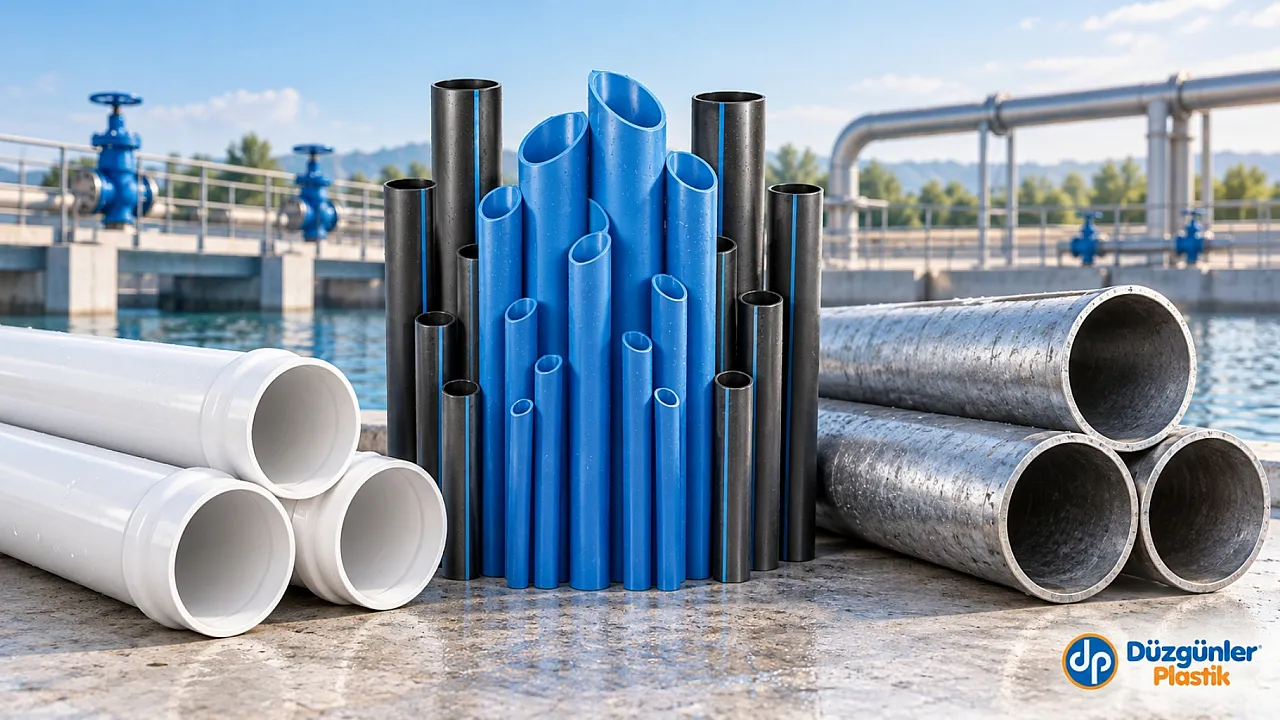

Kısa Özet: Hangi Boru Nerede Kullanılır?
U-PVC basınçlı temiz su boruları: Rijittir, geçme muflu bağlantıyla hızlı döşenir, paslanmaz.
HDPE PE100 boruları: Esnektir, kaynakla birleştirilir, zemin hareketini tolere eder.
Çelik boru: En yüksek mekanik dayanımı sunar; ancak korozyona karşı korunması gerekir.
Bu rehber, plastik boru üretimine 1996 yılında Konya 3. Organize Sanayi Bölgesi yatırımıyla odaklanan Düzgünler Plastik teknik ekibinin üretim deneyimine dayanır. Amaç, satın alma ve proje ekiplerinin doğru boruyu sade ölçütlerle seçmesidir.
U-PVC Basınçlı Temiz Su Boruları Hangi Hatlarda Tercih Edilir?
U-PVC basınçlı temiz su boruları; içme suyu şebekesi, altyapı ve endüstriyel su hatlarında tercih edilir. Düzgünler Plastik bu boruları 4 ila 16 Atm basınç dayanımıyla üretir. PVC-U basınçlı boruların ürün gereklilikleri uluslararası düzeyde ISO 1452-2 standardı ile tanımlanır.
Bağlantı: Geçme muflu veya yapıştırma muflu tiplerle birleştirilir. Kaynak makinesi gerekmez.
Korozyon: Paslanmaz; kimyasallara dirençlidir.
Montaj: Hafiftir, düz boylar halinde hızlı döşenir.
Sınırı: Rijit olduğu için zemin oturmasına ve sert darbeye karşı HDPE kadar toleranslı değildir.
Düzgünler Plastik ürün gamında geçme muflu, yapıştırma muflu ve deve boynu temiz su borusu tipleri bulunur.
HDPE PE100 Boruları Basınçlı Su Hatlarında Ne Avantaj Sağlar?
HDPE PE100 boruları esnek yapısıyla öne çıkar. Düzgünler Plastik, HDPE PE100 borularını TS EN 12201-2 standardına ve ISO 9001:2015 kalite yönetim sistemine uygun üretir. Temiz su, içme suyu ve tarımsal sulama hatlarında kullanılır.
Bağlantı: Alın kaynağı veya elektrofüzyon ile birleştirilir. Hat tek parça gibi davranır.
Esneklik: Zemin hareketini ve kıvrımlı güzergâhı tolere eder.
Form: Rulo (kangal) ve düz boru seçenekleri vardır. Rulo boru ek yeri sayısını azaltır.
Akış: Düşük sürtünme katsayısı pompa enerjisini azaltmaya yardım eder.
Sınırı: Kaynak için makine ve eğitimli operatör gerekir.
PE 100 boru basınç sınıfı SDR değeriyle belirlenir: SDR 17 boru PN 10, SDR 11 boru PN 16 sınıfındadır.
Çelik Boru Basınçlı Su Hatlarında Ne Zaman Gerekir?
Çelik boru; çok yüksek basınç, yüksek sıcaklık veya açıkta mekanik darbe riski olan noktalarda gerekir. Su iletimi için çelik borular EN 10224 standardı kapsamındadır.
Artısı: Mekanik dayanımı en yüksek seçenektir. Sıcaklık arttığında plastik borular gibi basınç kaybına uğramaz.
Eksisi: Paslanır. Kaplama ve çoğu zaman katodik koruma ister.
Eksisi: Ağırdır; taşıma, kaynak ve montaj işçiliği daha fazladır.
Bu nedenle gömülü soğuk su hatlarının büyük bölümünde plastik borular, özel koşullarda ise çelik boru tercih edilir.
U-PVC vs HDPE vs Çelik: Karşılaştırma Tablosu
Kriter | U-PVC basınçlı boru | HDPE PE100 boru | Çelik boru |
|---|---|---|---|
Yapı | Rijit | Esnek | Rijit, çok dayanıklı |
Bağlantı | Geçme veya yapıştırma muf | Alın kaynağı, elektrofüzyon | Kaynak veya flanş |
Korozyon | Paslanmaz | Paslanmaz | Koruma gerekir |
Zemin hareketi | Sınırlı tolerans | Yüksek tolerans | Sınırlı tolerans |
Montaj ekipmanı | Basit | Kaynak makinesi | Kaynak ve kaldırma ekipmanı |
Tipik kullanım | Şebeke ve altyapı hattı | Hareketli zemin, sulama, uzun hat | Çok yüksek basınç ve sıcaklık |
Basınçlı Su Hattı İçin Boru Nasıl Seçilir?
İşletme basıncını ve su sıcaklığını belirleyin.
Zemini değerlendirin: oturma veya deprem riski varsa HDPE PE100 boruları öne çıkar.
Güzergâhı inceleyin: düz ve sabit hatlarda U-PVC basınçlı temiz su boruları hızlı döşenir.
Sahadaki ekip ve ekipmanı dikkate alın.
Standart ve kalite belgelerini üreticiden isteyin.
Derin Kuyuda Durum Farklı mı? U-PVC Derin Kuyu Boruları
Evet, farklıdır. Suyu kuyudan yüzeye çıkaran dikey hat, basınçlı dağıtım hattından ayrı bir üründür. Burada U-PVC derin kuyu boruları kullanılır.
U-PVC kolon boruları: Dalgıç pompayı taşır. DCP serisi kare diş ve “O” ring ile bağlanır.
U-PVC sondaj boruları: Kuyu cidarını oluşturur. 100, 300 ve 500 metre derinlik seçenekleriyle, TS 11794 standardına uygun üretilir.
Kuyudan çıkan su, yüzeyde U-PVC basınçlı temiz su boruları veya HDPE PE100 boruları ile dağıtılır. Düzgünler Plastik, Türkiye’de dalgıç pompa plastik kolon borusu üretimini ilk gerçekleştiren firmadır.
Yazar: Düzgünler Plastik Teknik Ekibi Bu içerik, Konya 3. Organize Sanayi Bölgesi’nde üretim yapan Düzgünler Plastik ekibi tarafından hazırlanmıştır. Firma, üretim hattındaki makineleri kendi Ar-Ge departmanıyla tasarlar. Ürün bilgileri firma ürün dokümanlarına dayanır.
Sıkça Sorulan Sorular - S.S.S
U-PVC boru mu, HDPE boru mu daha dayanıklıdır?
İkisi de doğru koşulda uzun ömürlüdür. Sabit zeminde U-PVC, hareketli zeminde HDPE PE100 boruları daha güvenli sonuç verir.
İçme suyu hattında hangi boru kullanılır?
İçme suyu hatlarında hem U-PVC basınçlı temiz su boruları hem de HDPE PE100 boruları kullanılır. Seçim zemine, basınca ve montaj imkânına göre yapılır.
Çelik boru yerine plastik boru kullanılabilir mi?
Gömülü soğuk su hatlarının çoğunda evet. Çok yüksek basınç veya sıcaklık varsa çelik boru gerekir.
PE 100 boru kaç bar basınca dayanır?
SDR değerine bağlıdır. PE 100 boru SDR 17’de PN 10, SDR 11’de PN 16 basınç sınıfındadır.
U-PVC temiz su borusu kaç atmosfer basınca dayanır?
Düzgünler Plastik U-PVC basınçlı temiz su boruları 4 ila 16 Atm basınç dayanımıyla üretilir.
Ziyaretçilerimizin Sorduğu Sorular - PAA
Plastik su borusu paslanır mı?
Hayır. U-PVC ve HDPE borular paslanmaz; bu yüzden kaplama veya katodik koruma gerektirmez.
HDPE boru nasıl birleştirilir?
Alın kaynağı veya elektrofüzyon yöntemiyle birleştirilir.
Pvc temiz su borusu yer altına döşenir mi?
Evet. Pvc temiz su borusu gömülü şebeke hatlarında yaygın olarak kullanılır.
Deprem bölgesinde hangi su borusu tercih edilir?
Zemin hareketini tolere eden esnek yapısı nedeniyle HDPE PE100 boruları öne çıkar.
Meta Title: uPVC vs HDPE vs Steel Pipe for Pressure Water Lines (51) Meta Description: How do uPVC pressure pipe, HDPE PE100 pipe and steel pipe differ in pressure water lines? Compare pressure, jointing, corrosion and ground behaviour. (149) Focus keyword: HDPE PE100 pipe (secondary: uPVC pressure pipe) Main category: U-PVC Pressure Clean Water Pipes and HDPE PE100 Pipes
uPVC, HDPE and Steel Pipes in Pressure Water Lines: What Are the Differences?
In pressure water lines, uPVC pressure pipe suits straight network mains on stable ground, HDPE PE100 pipe suits moving ground and long continuous runs, and steel pipe is used where pressure or temperature is very high or the line is exposed to mechanical impact. The key differences are flexibility, jointing method and corrosion behaviour.
Quick Summary: Which Pipe Goes Where?
uPVC pressure pipe: Rigid, quick to lay with socket joints, does not rust.
HDPE PE100 pipe: Flexible, joined by welding, tolerates ground movement.
Steel pipe: Highest mechanical strength, but needs corrosion protection.
This guide draws on the production experience of Düzgünler Plastik, a manufacturer based in the Konya 3rd Organized Industrial Zone in Türkiye that has focused on plastic pipe since 1996. It is written for buyers and engineers, including project teams in Spain and Morocco.
Where Is uPVC Pressure Pipe the Right Choice?
uPVC pressure pipe is used in drinking water networks, infrastructure and industrial water lines. Düzgünler Plastik produces its U-PVC pressure clean water pipes with a pressure resistance of 4 to 16 Atm. Product requirements for PVC-U pressure pipe are defined internationally in ISO 1452-2.
Jointing: Push-fit socket or solvent weld socket. No welding machine is needed.
Corrosion: It does not rust and resists chemicals.
Installation: Light, supplied in straight lengths and quick to lay.
Limit: Because it is rigid, it tolerates settlement and hard impact less than HDPE.
The range includes push-fit socket, solvent weld socket and gooseneck potable water pipe types.
What Does HDPE PE100 Pipe Offer in Pressure Water Lines?
HDPE PE100 pipe stands out for its flexibility. Düzgünler Plastik produces HDPE PE100 pipes in accordance with EN 12201-2 (TS EN 12201-2) and the ISO 9001:2015 quality management system. They are used in clean water, drinking water and agricultural irrigation lines.
Jointing: Butt fusion or electrofusion. The line behaves like one continuous pipe.
Flexibility: It tolerates ground movement and curved routes.
Form: Coils and straight lengths. Coiled pipe reduces the number of joints.
Flow: A low friction coefficient helps reduce pumping energy.
Limit: Welding needs a machine and a trained operator.
The pressure class of a PE100 pipe follows its SDR: an SDR17 pipe is PN10 and an SDR11 pipe is PN16.
When Is Steel Pipe Needed in Pressure Water Lines?
Steel pipe is needed where pressure or temperature is very high, or where the line is exposed to mechanical impact. Steel tubes for water conveyance are covered by EN 10224.
Pro: The highest mechanical strength. It does not lose pressure rating with temperature the way plastic pipes do.
Con: It rusts. It needs coating and often cathodic protection.
Con: It is heavy, so transport, welding and installation take more labour.
For this reason, most buried cold water lines use plastic pipe, and steel is kept for special conditions.
uPVC vs HDPE vs Steel: Comparison Table
Criterion | uPVC pressure pipe | HDPE PE100 pipe | Steel pipe |
|---|---|---|---|
Structure | Rigid | Flexible | Rigid, very strong |
Jointing | Push-fit or solvent weld socket | Butt fusion, electrofusion | Welding or flanges |
Corrosion | Does not rust | Does not rust | Protection required |
Ground movement | Limited tolerance | High tolerance | Limited tolerance |
Installation equipment | Simple | Welding machine | Welding and lifting equipment |
Typical use | Network and infrastructure mains | Moving ground, irrigation, long runs | Very high pressure and temperature |
How Should Buyers in Spain and Morocco Choose?
The same criteria apply in Spain and Morocco as anywhere else; what changes is the project. The EN standards cited here are European standards, so buyers in Spain can check them directly in their specifications.
Define the operating pressure and water temperature.
Assess the ground: where settlement or seismic risk exists, HDPE PE100 pipe is the safer option.
Check the route: on straight, stable runs, uPVC pressure pipe is quick to lay.
For irrigation projects in Spain and Morocco, consider coiled HDPE irrigation pipe for long field lines.
Ask the manufacturer for standard and quality documents, and confirm any national approval required for potable water pipe in Spain or Morocco.
Is It Different in Deep Wells? U-PVC Deep Well Pipes
Yes. The vertical line that lifts water from the well is a different product from a pressure distribution line. This is where U-PVC deep well pipes are used.
uPVC column pipe: Carries the submersible pump. The DCP series joins with square threads and an “O” ring.
U-PVC deep well pipes (casing): Line the borehole. They are offered for 100, 300 and 500 metre depths and produced to TS 11794.
Once the water reaches the surface, it is distributed with uPVC pressure pipe or HDPE PE100 pipe. Düzgünler Plastik was the first company in Türkiye to produce plastic column pipes for submersible pumps.
Author: Düzgünler Plastik Technical Team This article was prepared by the Düzgünler Plastik team, which manufactures in the Konya 3rd Organized Industrial Zone and designs its production machinery in-house through its R&D department. Product data comes from company product documents.
Frequently Asked Questions
Which is more durable, uPVC or HDPE pipe?
Both last long in the right conditions. uPVC pressure pipe suits stable ground; HDPE PE100 pipe is safer on moving ground.
Which pipe is used for drinking water lines?
Both PVC-U pipe and HDPE water pipe are used as potable water pipe. The choice depends on ground, pressure and installation resources.
Can plastic pipe replace steel pipe?
In most buried cold water lines, yes. Where pressure or temperature is very high, steel pipe is needed.
What pressure can a PE100 pipe handle?
It depends on the SDR. A PE100 pipe is PN10 at SDR17 and PN16 at SDR11.
What pressure can uPVC pressure pipe handle?
Düzgünler Plastik U-PVC pressure clean water pipes are produced with a pressure resistance of 4 to 16 Atm.
People Also Ask - PAA
Does plastic water pipe rust?
No. uPVC and HDPE pipes do not rust, so they need no coating or cathodic protection.
How is HDPE pressure pipe joined?
By butt fusion or electrofusion welding.
Can PVC water main pipe be buried?
Yes. PVC water main pipe is widely used in buried network lines.
Which water pipe is preferred in seismic areas?
HDPE PE100 pipe, because its flexible structure tolerates ground movement.
